



The Office of the President has issued a directive ordering the Tema Metropolitan Assembly (TMA) and TDC Ghana Limited to resolve their long-running institutional dispute and establish a clear framework for collaboration, following a public confrontation that saw the demolition of portions of a government-backed development project.
In a letter dated 28 August 2026, the Presidency affirmed the TMA as the highest political and administrative authority within the Tema Metropolis, with responsibility for overall development, human settlements, municipal services, revenue mobilisation and local planning. The Presidency also maintained that the Assembly remains the local planning authority with exclusive responsibility for regulating physical development and issuing development and building permits within its jurisdiction.
TDC Ghana Limited, meanwhile, was described as a commercially oriented real estate developer rather than a municipal authority—a characterisation that directly challenges the company’s long-held position on its statutory mandate.
Roots of the Conflict: A 70-Year-Old Mandate Clash
The dispute traces its origins to 1952, when the then Tema Development Corporation was established under the Tema Development Corporation Ordinance to develop the new Tema township and port. Approximately 63 square miles of land—known as the Tema Acquisition Area—were compulsorily acquired from the traditional authorities of Tema, Nungua and Kpone and placed under TDC’s management through a 125-year lease.
TDC has long maintained that its statutory responsibility to “plan, lay out, and develop the Tema Area” remains intact, together with powers relating to housing schemes and industrial and commercial sites. The company argues that although some municipal functions were transferred to the then Tema District Assembly in 1989, it retained responsibility for planning and developing the Tema area.
The company’s conversion into a limited liability company in 2017, TDC argues, preserved the functions of the former corporation and expanded its powers to undertake real estate development as well as plan and develop towns and cities.
The Flashpoint: Community One Site 3
The confrontation escalated dramatically on Wednesday, 12 August 2026, when the TMA, led by Metropolitan Chief Executive Ebi Bright, ordered the halt of construction works at Community One, Sites 3 and 8, and subsequently demolished portions of structures at the project site.
The Assembly maintained that the development had commenced without the necessary permits, arguing that TDC’s ownership or management of land did not exempt the company from complying with physical planning and development laws.
Residents had reportedly petitioned the Assembly over concerns about the alleged felling of approximately 50 trees, demolition of existing structures, encroachment on playgrounds and green belts, and obstruction of access to homes and businesses. According to the MCE, the Assembly had issued several warnings to the contractors to suspend work pending resolution of the matter, but the directives were ignored.
TDC Managing Director Courage Makafui Nunekpeku, however, described the demolition as “extremely unfortunate” and inconsistent with the government’s commitment to infrastructure development and job creation. He maintained that the project—involving the construction of shops and office spaces—had gone through the necessary approval and procurement processes involving the Ministry of Finance, the Public Procurement Authority, and the Ministry of Works and Housing.
Nunekpeku further alleged that although TDC received a letter from the Assembly on 7 August giving the company seven days to comply, the demolition occurred just two days later, before the deadline had elapsed.
“Even the building where we are living, we built this building without a permit,” Nunekpeku said, adding that TDC shops at Community 18 and other infrastructure had similarly been developed without permits under a longstanding arrangement between the institutions.
A Question of Legal Authority
The legal disagreement centres on the interpretation of competing statutory mandates. MCE Bright cited the Local Governance Act and subsequent legislation passed in 2016, which she said reinforced the planning authority of Metropolitan, Municipal and District Assemblies. She argued that TDC ceased to operate in its former statutory form in 2017 and now operates as a commercial real estate company without regulatory or planning authority.
TDC, however, acknowledged the Assembly’s authority while insisting that its own mandate must be exercised alongside the Assembly’s powers. “TDC does not dispute that TMA is a statutory local government authority with responsibilities for physical planning, development control and municipal administration. The issue is whether that mandate can be exercised as though TDC’s separate statutory mandate does not exist,” the company said in an earlier statement.
The company also pointed to a Joint Technical Evaluation Committee previously established between TDC and assemblies within the Tema Acquisition Area as evidence of an existing mechanism for coordinating their overlapping responsibilities.
A Curious Exception
Observers have noted that TDC maintains the same institutional arrangement with four other assemblies across the Tema Acquisition Area—Kpone-Katamanso Municipal Assembly, Tema West Municipal Assembly, Ashaiman Municipal Assembly, and Krowor Municipal Assembly—without incident. According to TDC, the company provides land to these assemblies for public facilities without charging them and has historically undertaken its own developments without separately obtaining permits.
Of the relationships TDC has publicly described, only its relationship with TMA has produced the kind of stop-work order, demolition and legal standoff now unfolding in Tema.
Presidency Steps In
The confrontation prompted TDC to petition the Minister for Works, Housing and Water Resources, Kenneth Gilbert Adjei, and the Minister for Local Government, Chieftaincy and Religious Affairs, Ahmed Ibrahim, to intervene.
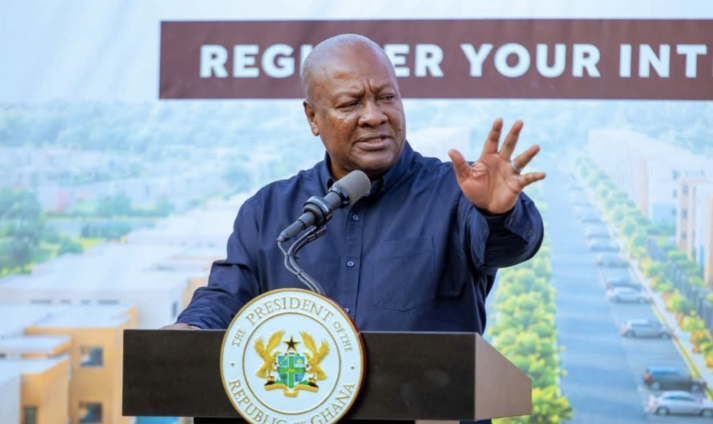
President John Dramani Mahama subsequently summoned both Bright and Nunekpeku to a meeting on Monday, 17 August, along with the sector ministers, to address the dispute directly. The Presidency has now followed up with a formal directive ordering both institutions to establish a clear operational framework to prevent further conflict.
President Mahama expects the TMA and TDC to cooperate fully and secure an immediate and lasting settlement, warning that any further institutional conflict, public confrontation or refusal to comply with the directive would be viewed seriously.
Labour experts have welcomed the intervention. Abraham Koomson, Secretary General of the Ghana Federation of Labour, described the dispute as pointing to a “lack of coordination” between the two institutions, a situation he said was worrying and potentially damaging to the government. He cautioned that continued public disagreements between state institutions could undermine public confidence and potentially have political consequences.
Bright has separately proposed a joint reconciliation committee to inventory permits and clarify TDC’s role going forward. The question now is whether those mechanisms will finally resolve the long-simmering dispute over who controls development in Ghana’s premier planned city.


