



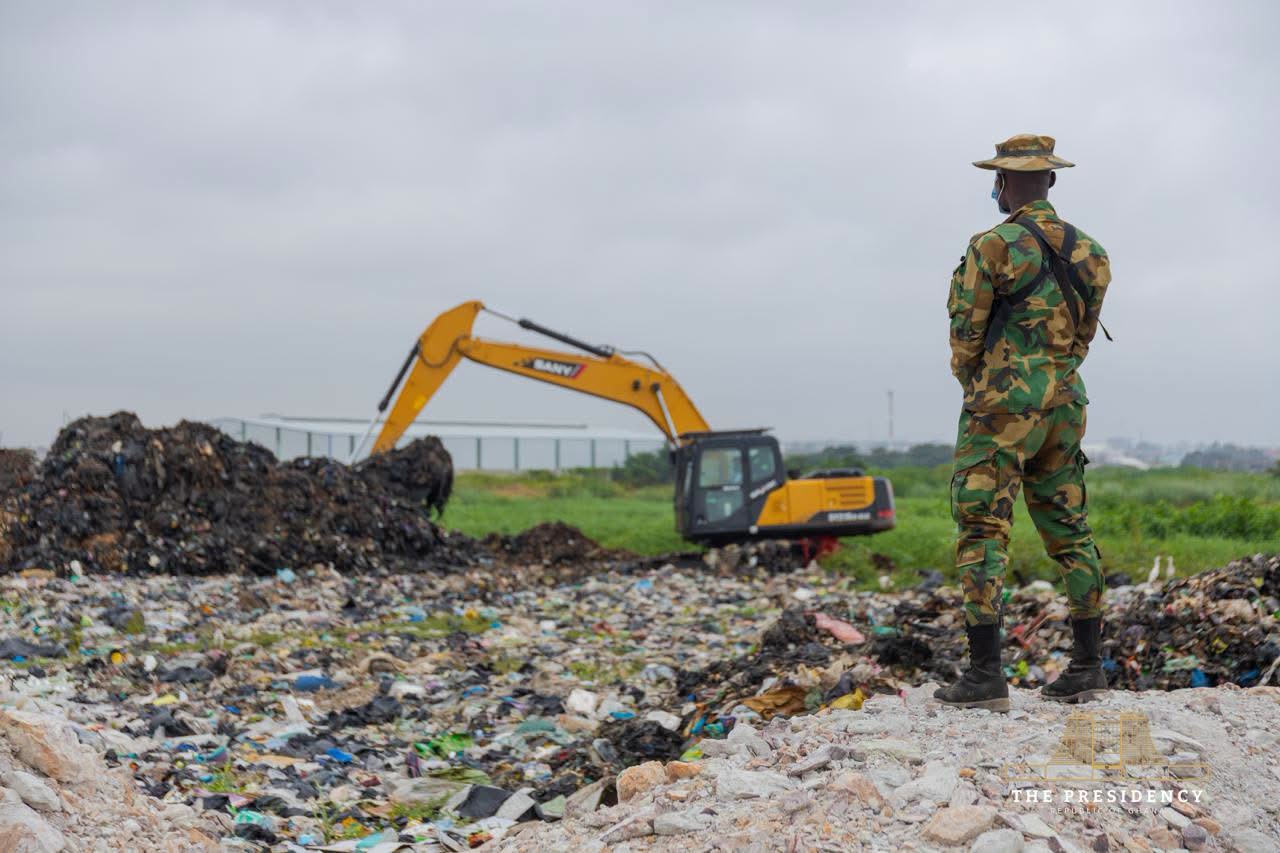
A major military-led operation has commenced to reclaim the Lafa water retention basin at Mallam, following years of illegal waste dumping and encroachment that transformed the natural reservoir into a flood hazard for surrounding communities.
The intervention, led by the 48 Engineer Regiment of the Ghana Armed Forces under the Post-Flood Mitigation Task Force, involves dredging the basin, demolishing illegal structures within the water reserve, constructing protective embankments, and evacuating waste to a landfill site at Nsawam.
The operation responds directly to the devastating floods of June 29, 2026, when torrential rains—measuring 169.2 millimetres, the fourth-highest daily rainfall recorded since 1995—inundated parts of Accra, claiming multiple lives and submerging areas including Mallam, Weija, and Dansoman.
Decades of Encroachment and Waste
The Lafa watercourse originates from Mallam-Gbawe Zero and flows through Santa Maria, Atieku, Pallas Town, Alhaji Tabora, and McCarthy Hill before entering the basin and discharging into the sea. However, over several years, the basin was deliberately filled with solid waste, boulders, and laterite—capped and compacted to create land for illegal sale and development.
Ing. Richard Kofi Amekor, Head of Drainage at the Ghana Hydrological Authority, described the clearing task as “very challenging”. He explained that heavy silting prevented rainwater from entering the basin during the June 29 downpour, forcing backwater to flood communities including Blue Lagoon and the Dansoman enclave.
“The topography in this area with the hills upstream obviously pushes more water into this basin, and the blockade causes the devastating floods,” he said. “Some buildings are within the basin, and they have reduced its capacity. All those illegal structures must go down”.
Months-Long Operation
Brigadier General Richard Kinney, Commander of the 14 Engineer Brigade, said the immediate task is to loosen compacted waste for removal. “We are trying to loosen the waste material dumped here for years, capped with laterite and compacted to secure part of the land for sale,” he stated. He disclosed that waste haulage would be conducted at night to the final disposal site at Nsawam and that the exercise would take several months to complete.
Broader National Effort
The Lafa Basin intervention is part of a broader national post-flood mitigation programme. Following an aerial assessment by President John Dramani Mahama, the government released GH¢300 million from the Contingency Fund for relief and mitigation, and established the National Post-Flood Mitigation Task Force.
Similar operations are ongoing at Oyarifa, East Legon, and the Kpeshie Lagoon area, with work expected to begin at the Kpeshie enclave and Laboma Beach to open the channel into the sea.
Brigadier General Forster Okae-Yeboah, Director General of Joint Operations at the Ghana Armed Forces and Coordinator of the Flood Mitigation Works, urged residents to cooperate with the task force and desist from activities that obstruct waterways. “Our goal is mitigating flood impacts in Accra,” he said.
While the intervention is expected to significantly reduce flooding, officials caution that it may not completely eliminate the risk. The government has pledged that the flood mitigation exercise will become a continuous, year-round programme rather than a one-off intervention.


