



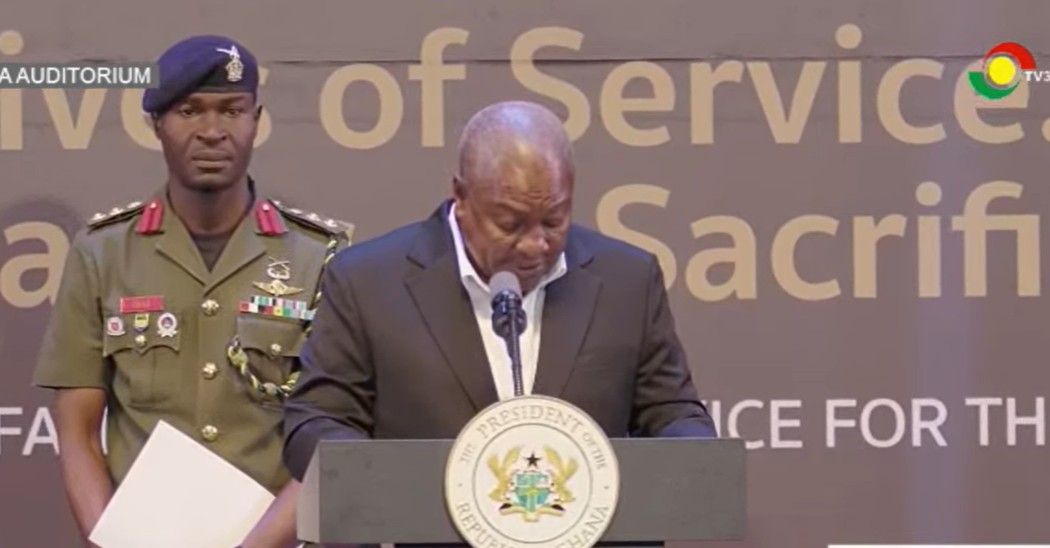
President John Dramani Mahama has urged Ghanaians, particularly those in positions of authority, to honour the memory of the eight heroes who perished in last year’s military helicopter crash by strengthening institutions, improving safety standards, and placing national service above personal interest.
Speaking at the National Inter-Faith Memorial Service held at the Accra International Conference Centre on Thursday to mark the one-year anniversary of the tragedy, President Mahama described the occasion as one of solemn remembrance and deep national introspection
“Today is one of those days that the nation slows its pace, not because history demands it, but because memory does. We gather because remembrance is an obligation for every grateful nation,” he stated.
A call for action, not symbolism
The President was emphatic that the finest tribute the nation could offer the departed was not a physical monument but a tangible commitment to responsible governance and the protection of those who serve the Republic.
“The greatest memorial we can build is not one made of stone or bronze; it is one built through responsible leadership, improved systems, and a steadfast commitment to protecting those who dedicate their lives to Ghana,” he remarked.
He stressed that the tragedy should serve as a permanent reminder to leaders that every decision made in public office carries profound consequences for human lives.
“Today should also be a moment of reflection for all of us who are entrusted with leadership—that every decision we make affects lives. Every public office is ultimately a sacred trust,” the President said.
“Their memory therefore imposes upon us a solemn obligation: to build stronger institutions, to reinforce safety standards wherever necessary, to invest in the welfare of our personnel, and to ensure that no lesson from this tragedy will ever be forgotten.”
The tragedy: A nation’s loss
The crash occurred on August 6, 2025, when a Ghana Armed Forces Z-9 helicopter went down in the Adansi Akrofuom District of the Ashanti Region while on a routine administrative flight from Accra. All eight personnel on board perished instantly.
The victims included two sitting ministers, a senior national security official, a former regional minister, a political candidate, and three military aircrew:
· Hon. Dr. Edward Kofi Omane Boamah – Minister for Defence, a respected academic and strategist who oversaw Ghana’s peacekeeping commitments.
· Hon. Dr. Ibrahim Murtala Muhammed – Minister for Environment, Science, Technology and Innovation, known for his advocacy on climate policy and scientific innovation.
· Alhaji Muniru Mohammed – Acting Deputy National Security Coordinator, a veteran civil servant with decades of intelligence and security experience.
· Dr. Samuel Sarpong – Former Ashanti Regional Minister, a medical professional who had also served in various public health roles.
· Mr. Samuel Aboagye – Former parliamentary candidate of the National Democratic Congress (NDC), remembered for his grassroots activism and community engagement.
· Squadron Leader Peter Bafemi Anala – A decorated pilot with over 2,000 flight hours and service in UN peacekeeping missions in Liberia and Lebanon.
· Flying Officer Manaen Twum Ampadu – A promising young aviator whose skill and professionalism had earned him early distinction.
· Sergeant Ernest Addo Mensah – A veteran flight engineer whose technical expertise had been instrumental in numerous successful missions.
Investigations and institutional reforms
In the year since the tragedy, the Ministry of Defence has commissioned an independent inquiry into the crash. Preliminary reports cited adverse weather conditions and potential operational factors, but final findings are still awaited. Families of the deceased have called for transparency, and President Mahama acknowledged their concerns, pledging that the government would see the investigation through to a thorough and impartial conclusion.
The anniversary has also catalysed a review of aviation safety protocols within the Ghana Armed Forces. Enhanced weather-monitoring systems, upgraded maintenance schedules, and expanded simulator training for pilots have been introduced—measures designed to prevent future tragedies.
A united nation in mourning
The memorial service drew a cross-section of the nation’s leadership. Vice President Professor Jane Naana Opoku-Agyemang, Chief of Staff Julius Debrah, and other senior government officials attended alongside the Ghana Armed Forces High Command, led by the Chief of Defence Staff.
Religious leaders from Christian, Muslim, and traditional faiths offered prayers and scriptural readings, while members of the diplomatic corps, including representatives from ECOWAS and the African Union, paid their respects. Traditional authorities from the Ashanti and Eastern Regions were also present, underscoring the national scope of the loss.
Nationwide, flags flew at half-mast on all public buildings, and a minute of silence was observed at 10:00 a.m., coinciding with the time of the crash. Churches, mosques, and community centres held parallel prayer vigils, while schools and workplaces paused for moments of reflection.
A charge for the future
As the service drew to a close, President Mahama left the congregation with a final exhortation.
“Let us leave this place with a renewed commitment to integrity, to selfless service, and to building a country where every citizen feels that their contribution to national development is valued,” he said.
“That is the truest monument we can raise—not of stone, but of character. Not of bronze, but of duty.”
The chaplain of the Ghana Armed Forces then offered a closing prayer: “May the souls of our departed compatriots continue to rest in perfect peace.”


