



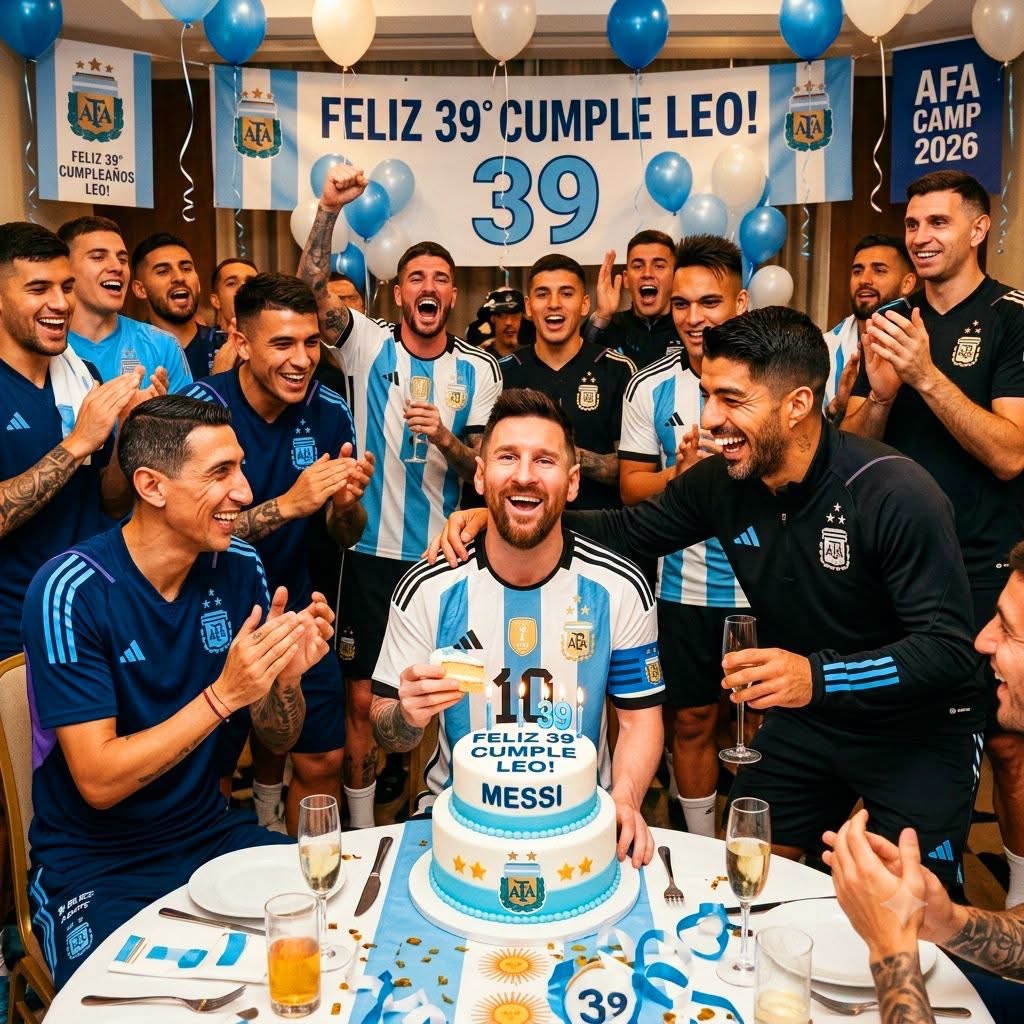
The calendar insists that Lionel Andrés Messi is 39 years old today. The numbers, however, tell a different story—one that belongs not to mere mortals, but to the very mythology of sport itself.
On a June 24 that once marked the birth of a shy, hormone-deficient boy in Rosario, Argentina, the footballing world now pauses to salute a man who has systematically dismantled every record, every defense, and every debate that has dared to stand in his way.
Thirty-nine. It is a number that feels almost incidental for a player who has spent two decades defying physics, logic, and the relentless march of time. As Messi celebrates his birthday in the pink and black of Inter Miami—still dazzling, still decisive, still the gravitational center of every match he graces—the sport he has dominated for so long finds itself struggling for superlatives that haven’t already been exhausted.
From Rosario to the Pantheon
The story has been told a thousand times, yet it never loses its capacity to enchant. A boy with a growth hormone deficiency, scouted on a napkin, whisked across the Atlantic to Barcelona’s La Masia. There, he didn’t just learn football; he reinvented it. By the time he was a teenager, he was already unsettling the greats. By his early twenties, he was the undisputed king of Catalonia—and soon, the entire planet.
His trophy cabinet is not merely a collection of silverware; it is a museum of human achievement. Forty-eight senior trophies, a number that defies comprehension. Ten Spanish La Liga titles with Barcelona, seven Copa del Reys, seven Spanish Super Cups. Four Champions League crowns, three UEFA Super Cups, and three FIFA Club World Cups. In France, he added two Ligue 1 titles and a Trophée des Champions to his collection. At the international level, he finally silenced his loudest critics with a World Cup in 2022—the crowning jewel—backed by two Copa América victories, an Olympic gold from Beijing 2008, and an U20 World Cup title from 2005. And just this past year, he added an MLS Cup to his ever-expanding resume, proof that the magic endures even in a new world.
But the trophies, staggering as they are, only tell half the tale.
The Numbers That Break the Mind
The raw statistical output of Messi’s career reads like a fever dream rather than a factual record. Across 1,158 official senior appearances—a testament to remarkable longevity given the battering he has absorbed from defenders for two decades—he has netted 916 goals. That is not merely a record; it is a mathematical anomaly, a figure that places him clear of every predator who has ever worn boots.
Yet the goal tally, extraordinary as it is, almost undersells his genius. He has supplied 414 assists, a number that elevates him from a goal-scorer to a creator of worlds. He has orchestrated 61 hat-tricks, leaving goalkeepers and defenders in collective despair. He is the all-time leading scorer for both FC Barcelona and the Argentine national team—records that, in all likelihood, will stand for generations.
And the individual accolades? The eight Ballon d’Or trophies no longer fit in a single display case. Six European Golden Shoes, sixteen Footballer of the Year awards, four World Footballer of the Year honors, three European Player of the Year titles, and the Golden Boy in 2005—an omen that was so prescient it now seems almost comical in its understatement.
The Crown That Silenced a Nation
For years, the only shadow over Messi’s luminosity was the absence of a World Cup. It was a cruel asterisk that his detractors wielded with glee, insisting that without that golden July afternoon, he could never eclipse Diego Maradona in the Argentine soul.
Then came Qatar 2022.
In one of the greatest finals ever contested, Messi delivered not just a trophy, but a coronation. He scored twice, danced through the French defense, and lifted the one prize that had eluded him. The roar from the Lusail Stadium was not just for a champion; it was for a debt finally repaid. With that victory, the debate was extinguished. He had scaled the absolute peak.
A Legacy Beyond Trophies
Today, at 39, Messi is no longer the fleet-footed teenager who dribbled past Getafe’s entire defense. The electric bursts are a fraction slower. The hair is shorter, the beard grayer. But the footballing brain remains terrifyingly sharp. At Inter Miami, he has transformed the club’s fortunes, drawing crowds that treat him not as an athlete, but as a visiting deity. Every free-kick he lines up still draws held breath; every turn still sparks gasps.
His birthday arrives amid quiet speculation about the 2026 World Cup—a tournament he has suggested could be his last. At 39, the prospect of leading Argentina on North American soil seems audacious, even for him. Yet those who have learned to never bet against him know better. If anyone can defy Father Time one final time, it is the man from Rosario.
As the tributes pour in from every corner of the globe—from teammates who worshipped him, defenders who suffered him, and fans who wept for him—one truth remains unassailable. We are living in the era of Messi. We have witnessed the complete works of the most complete footballer to ever grace a pitch.
Forty-eight trophies. Nine hundred and sixteen goals. Eight Ballon d’Ors. One immortal legacy.
Happy birthday, Lionel. The game has never seen your like—and it never will again.


