



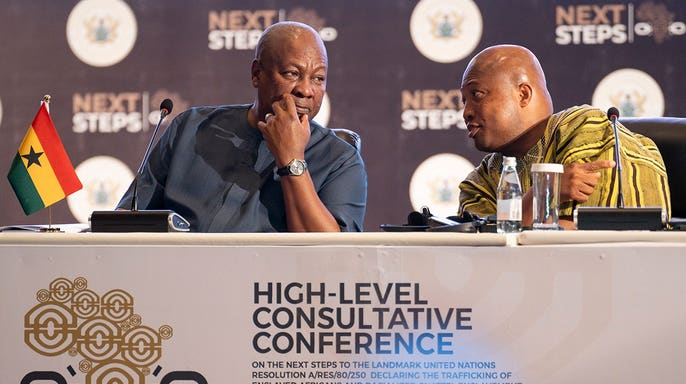
African and Caribbean leaders officially adopted a unified, 19-point reparations framework on Friday, concluding a high-level three-day consultative conference in Accra that brings together the African Union and the Caribbean Community (CARICOM). The sweeping plan demands financial compensation, formal apologies from Western nations, debt cancellation, and the establishment of a “Global Reparations Fund” to address the enduring economic consequences of the transatlantic slave trade.
The agreement aims to consolidate separate reparations efforts previously pursued by the two regions into a single document, which will be formally presented at the upcoming United Nations General Assembly. The framework also includes demands for the return of looted cultural artifacts and ancestral remains held in Western institutions, reforms to international financial bodies like the World Bank and IMF, and expanded citizenship pathways for descendants of the African diaspora.
Symbolic Memorial and Defining Quotes
During the conference, Ghanaian President John Dramani Mahama, alongside Barbados Prime Minister Mia Amor Mottley, led delegates in a wreath-laying ceremony at Christiansborg Castle in Accra. The historic site, a former Danish trading post that served as a major hub for the slave trade, carries deep symbolic significance for the “Door of No Return.”
Addressing the assembly, Mahama emphasized intergenerational responsibility over personal blame. “None of us gathered in this hall today can be held personally responsible for the atrocities of the transatlantic slave trade,” he said. “History does not ask us to inherit guilt, but it asks us to inherit responsibility.”
International Pushback and Obstacles
The unified push follows a landmark UN vote in March that recognized the transatlantic slave trade as the “gravest crime against humanity.” While 123 nations voted in favor, the United States and Israel voted against the resolution, and the European Union abstained. US and EU diplomats have voiced concerns that such resolutions could create a “hierarchy” among human rights atrocities, implying some historical crimes are more severe than others—a stance that could complicate ratification of the 19-point framework when it reaches the global stage.
Macron’s Cautious Acknowledgement
French President Emmanuel Macron addressed the conference virtually from the Élysée Palace. He acknowledged the horrors endured by enslaved people, stating they were “torn from their homelands, deported, dehumanised, and treated as goods.” However, Macron offered a tempered warning regarding reparations, cautioning that the process should not be viewed merely as an “end point, or a cheque written to bring the story to a close.” He urged a broader, ongoing dialogue about historical impact.
Next Steps
With heads of state from Namibia, Liberia, Senegal, Sao Tome and Principe, and senior officials from several other nations in attendance, the coalition now moves to formalize its diplomatic strategy. The 19-point plan will be used as a unified negotiating tool at the UN, pressing Western nations to respond to calls for a legally binding mechanism to address past atrocities.
For exclusive breaking news updates on this developing story and international diplomatic negotiations, click here to subscribe to our direct alerts.


